The Meditation Manuals
The Scripture on Ānāpāna
The Mindfulness of Breathing Sutra of An Shigao — China's First Meditation Book
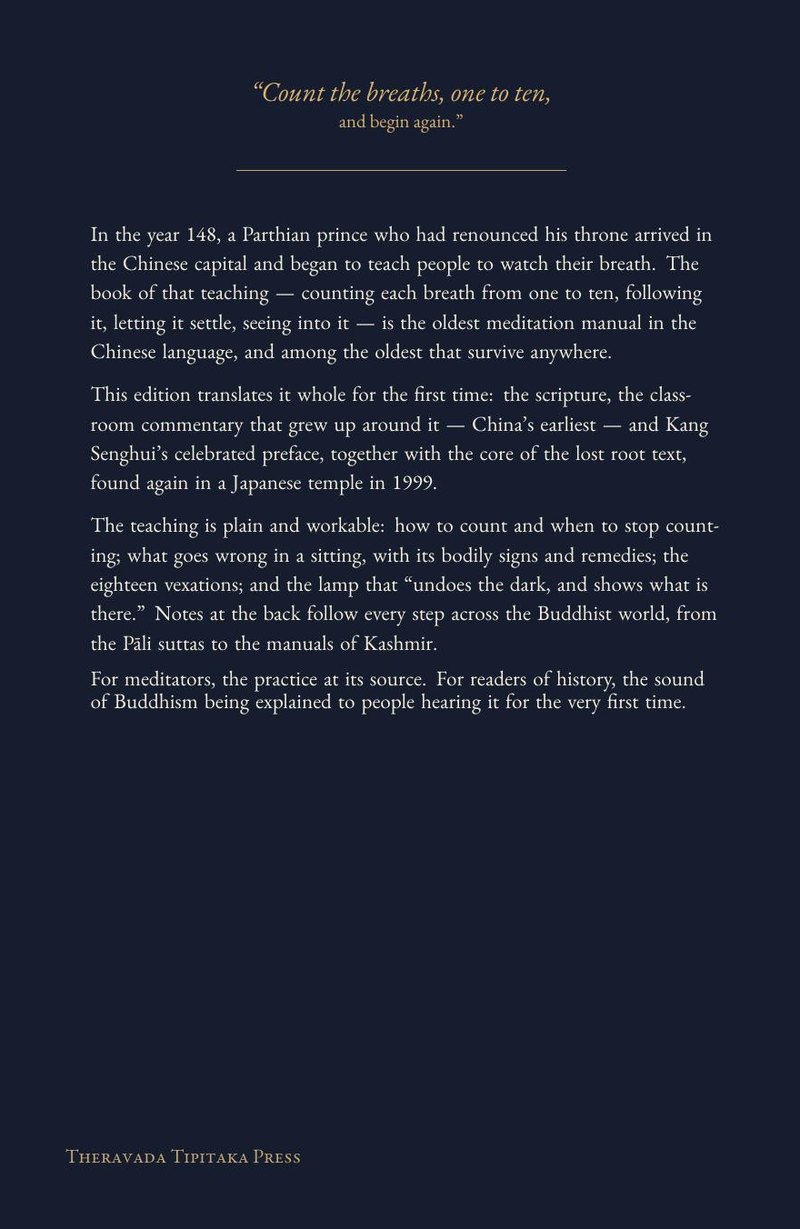
In the year 148, a Parthian prince who had renounced his throne arrived in the Chinese capital and began to teach people to watch their breath.
The book of that teaching — counting each breath from one to ten, following it, letting it settle, seeing into it — is the oldest meditation manual in the Chinese language, and among the oldest that survive anywhere. This edition translates it whole for the first time: the scripture, the classroom commentary that grew up around it (China's earliest surviving commentary on any text), and Kang Senghui's celebrated third-century preface — together with the core of the lost root text, missing for centuries and found again in a Japanese temple in 1999.
Alongside the practice runs a history found in no other book: the sound of Buddhism being explained to people hearing it for the very first time. The similes come from a Han listener's own day — counting coins, buying gold and being handed stone, a cart and a fast walk among the “spirit-feet” — and the seed of the sudden-versus-gradual debate that would divide Chinese Buddhism for a thousand years is already here, in a single sentence.
For meditators: the practice at its source, with the six aspects — counting, following, fixing, observing, returning, purifying — that shaped breath-meditation from Kashmir to Kyoto. For scholars: a fully documented edition, with the recovered Kongō-ji root text set apart from the commentary, four-way parallels to the Pāli canon, the Sanskrit treatises, and the Vimuttimagga, and endnotes tracing every doctrinal step.
Inside this edition
- How to count the breaths — and the two ways the counting fails
- When not to count: a thought in progress, an unsettled breath, noise
- The four failed sittings, each with its bodily sign and its remedy
- The eighteen vexations that keep a person from the practice
- The lamp that “undoes the dark, and shows what is there”
- Why the breath, of all objects: “in the breath there are none of the five”
- An appendix following the breath into the laboratory — slow breathing, the vagus nerve, and breath-counting as a validated measure of attention
From the book